

No products in the cart.

Why American Roofers Should Consider installing PREFA Aluminum Roofing
In much of the American roofing market, speed and simplicity often win. Panels get cut, joints get sealed, and the system relies heavily on caulks and sealants to keep water out. It works – at least for a while.
But there’s a fundamental flaw in that approach: sealants don’t last as long as the metal does, especially when baking in sun.
Across Europe, a different philosophy has been standard for decades. Instead of relying on chemical seals, roofers rely on mechanical water-shedding details—folds, seams, and interlocks that physically prevent water from entering the system. One of the materials that makes this possible is PREFA aluminum.
For American roofers looking to elevate their craft, reduce callbacks, and build longer-lasting systems, PREFA is worth serious attention.
The Problem with “Cut and Caulk” Metal Roofing
“Cut and caulk” roofing is exactly what it sounds like. Metal is cut to fit, joints are assembled, and sealant is applied to close gaps and prevent water intrusion. This is commonly seen on flashings around chimneys, dormers, pipes etc. While there is a time and a place for caulking/sealant, too many roofers are relying on them heavily and creating weak points that will ultimately drag down the metal roofing industry as a whole.
The problem is not immediate – it’s long-term.
Sealants degrade. UV exposure breaks them down. Thermal expansion and contraction cause them to crack. Over time, even the best products fail. When they do, water finds its way in.
This leads to:
- Leaks
- Callbacks
- Ongoing maintenance
- Customer frustration
In short, the system is only as good as its weakest point—and that point is often the sealant.
What Makes PREFA Aluminum Different
PREFA aluminum isn’t just another metal roofing product. Its defining characteristic is malleability.
Much like copper, PREFA aluminum can be:
- Bent
- Folded
- Shaped
- Formed on-site
This flexibility allows roofers to create true mechanical connections instead of relying on sealants to do the work.
It’s lightweight, corrosion-resistant, and durable, but the real advantage is how it can be worked and folded to express yourself as a metal roofer and create roofs that last as long as the metal itself.

Folding Over Sealing
The biggest shift when working with PREFA is moving from sealing to folding.
Instead of cutting a joint and sealing it with caulk, you:
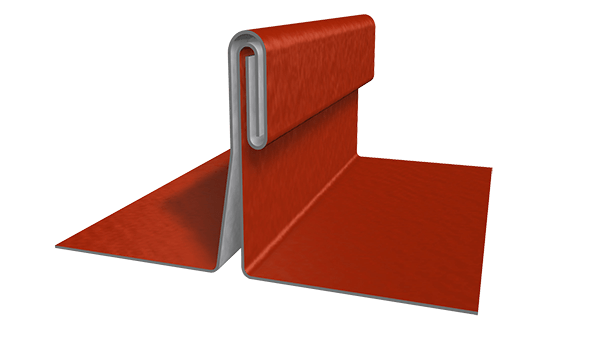
- Fold edges into seams
- Lock panels together mechanically
- Create hems and interlocks that shed water naturally
Systems like double-lock standing seams are designed so that water simply cannot penetrate when properly installed. There’s no dependency on a sealants or caulking that will degrade. The waterproofing is built into the geometry of the metal itself.
The techniques to install can be taught to eager metal roofers. Stortz Tools will be hosting PREFA sponsored trainings in 2026 with a qualified PREFA trainer. Enter your information at this link (PREFA TRAINING) to express interest in upcoming trainings.

Why Malleability Changes Everything
Not all metals behave the same.
Domestic steel is strong but stiff. Many pre-finished panel systems limit what you can do in the field. You’re often forced into standardized details and when those don’t fit perfectly, you reach for sealant.
PREFA aluminum is different.
Because it bends like copper, you can:
- Form custom flashings on-site
- Wrap complex penetrations
- Execute tight, precise folds around transitions
- Adapt to real-world conditions instead of forcing the roof to fit the product
That flexibility means fewer compromises—and fewer opportunities for failure.
Performance That Lasts
When you compare a folded system to a sealed system, the difference becomes clear over time.
A properly executed folded detail:
- Doesn’t dry out
- Doesn’t crack
- Doesn’t rely on maintenance
It simply continues to shed water, year after year.
For contractors, that means:
- Fewer callbacks
- Lower warranty risk
- Stronger reputation
For clients, it means a roof that performs the way they expect—for decades.
A Competitive Advantage for U.S. Roofers
Learning to work with PREFA aluminum isn’t just about materials—it’s about positioning.
Most of the U.S. market still operates on faster, lower-skill installation methods. By developing folding and forming skills, you separate yourself from that crowd.
You’re no longer just installing roofing—you’re practicing a craft.
That opens the door to:
- Higher-end projects
- Architectural work
- Better margins
- Clients who value longevity over shortcuts
Yes, There’s a Learning Curve
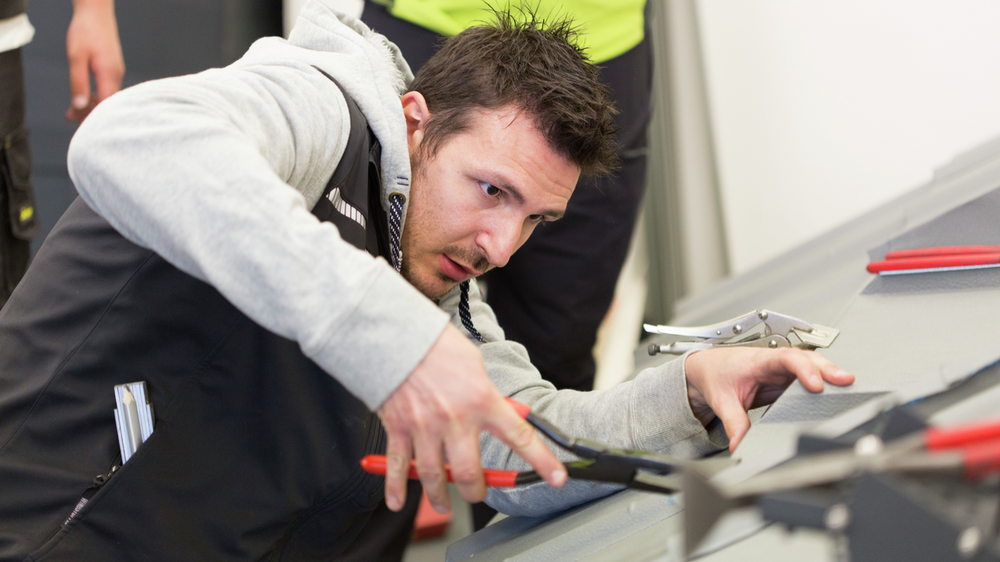
This isn’t a plug-and-play system and we are here to help you gain the skills you need. Visit our PREFA TRAINING page to let us know if you have an interest in scheduling a training for you or your crew. We will contact you and discuss details.
It requires:
- The proper tools
- New techniques
- A different mindset
You’re shifting from assembling components to fabricating solutions.
But that investment pays off. Once you understand how to work the material, you gain a level of control and capability that “cut and caulk” systems simply can’t offer.

Conclusion: Folding Beats Failing
At its core, the argument is simple:
Sealants fail. Properly folded metal doesn’t.
PREFA aluminum gives American roofers the ability to build roofs the way they’ve been built successfully in Europe for generations—through precision, craftsmanship, and mechanical water-shedding design.
For those willing to learn it, the reward isn’t just a better roof.
It’s a better business.
About Us
John Stortz & Son, Inc. was founded in 1853 by the original John Stortz in Philadelphia. Currently headed by Tom, Jeff, and Sam, along with their dad and uncle; Stortz Tools continues to serve the tool industry quality specialty hand tools after over 170 years.
Related Posts


Follow us on instagram
#STORTZTOOLS

